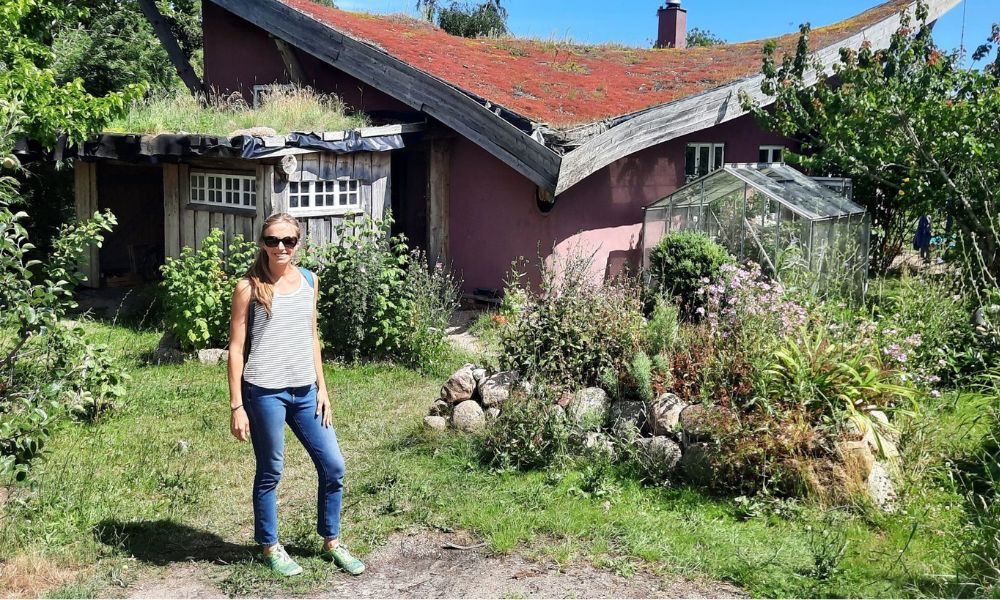
On a crisp day in March 2022, I caught up with Cynthia Tina over Zoom from her home space at Headwaters, a multigenerational Ecovillage of eight households on 14 acres near the Winooski River in Vermont. The intentional community has a garden, orchard, meadow, and greenhouse, and most inhabitants built their own homes using natural, sustainable building techniques and permaculture principles. Those innovators included Tina, who was in the process of creating a passive solar home and permaculture garden.
Tina explained she had just come in from a walk in the surrounding woods; her face was flushed, her eyes bright, and she radiated energy.
At the time, she was serving as the co-director of the Foundation for Intentional Community. She currently is a speaker, educator, and consultant through her businesses Ecovillage Tours and CommunityFinders.
As a “matchmaker,” Tina specializes in connecting people to intentional communities that would be a good fit — drawing on more than a decade of travels to communities worldwide and an active network of more than 100 sites. Her mission is to help bridge the gap between intentional community and mainstream society.
“I’m here to tell you… your vision of living in a supportive community of like-minded people IS possible,” she writes on her website.
She has a degree in Sustainability from Goddard College and certifications in Ecovillage and Permaculture design, as well as Yoga Teacher Training.
Tina spoke with me about intentional community, finding her own community, and her advice for seekers. Answers below have been edited for length.
To learn more or connect with Cynthia Tina, check out her website here. You can also find her on Facebook and Instagram.
You can also listen to the interview on Spotify!
A Q&A with Cynthia Tina: Founder of CommunityFinders

How did you find Headwaters? How did you know it was your place?
I was really wanting to put down roots somewhere, and I knew I wanted to live in an intentional community. My family is here in Vermont, and it’s where I feel the strongest connection. So I started looking at communities in Vermont more seriously. Headwaters is one of the few communities in the world of intentional communities where you can build your own home. This had been a lifelong dream of mine, to design and build a house, so that was a big selling point.
I visited during the summer when the gardens were lush and full and kids were running around. I had this feeling that this was a really peaceful place. I didn’t want to be in a big community; I wanted something low key that had a strong focus on permaculture and families and had lots of woods around. Headwaters checked off so many boxes for me, so I decided to go for it.
You never really know how it’s going to turn out or if this is the perfect place. But this seemed good enough, and I was ready for the adventure.
How does living in an Ecovillage allow you to connect more closely with the Earth?
I just got back from an hour walk in the woods; it’s really important that I do that regularly for my mental health. Headwaters is great, and a lot of the more rural communities are surrounded by woods and have access to nature. And then in our community, and in a lot of Ecovillages, we’re focused on growing food. Everyone lends a hand in making the gardens happen. Our community acreage is quite small, but surrounding the community are a lot of woods and farms. So in the winter, there’s this network of cross country ski trails that comes alive in the winter months, and people are able to get out and about.
Is the disconnect from each other and nature a source of dis-ease in society today?
The disconnect from place, each other, and our own psyche — the connection to our own selves — that’s the root of all the other challenges and symptoms that stem from that.
I wouldn’t want to mislead you; a lot of people who live in community have jobs, and they have busy lives. It’s not like you join a community and then all that goes away. But at least you are in a community with other people who are striving toward that slower pace and to have more connectivity, and you have more systems of support.
You felt a curiosity about other ways of living when you were younger, and you had the courage to follow that tug — what was that like?
I did take a leap in pursuing this lifestyle, and it has been, especially earlier in my younger years, very scary. A lot of unknowns.
I did a program while I was at St. Lawrence University called the Adirondack Semester, and we lived in a little village of yurts with the students. We had all our classes outside, and our professors came to us. It was incredible, and one of my first community experiences without really knowing that we were creating an intentional community. I used that semester to decide to transfer to a different school, and this was a very big decision for me.
I remember standing at the little boardwalk/dock we had out at the lake, and feeling like, “I’m stepping into the unknown. I’m falling into this void, and I don’t know if I’m going to land or not, or how I’m going to land.”
I think whether people are thinking of joining an intentional community or some other big life transition, it’s a similar feeling. We don’t know the future, of course, so there’s a risk, especially since society tells us that these communities are not fully acceptable. There are a lot of stereotypes, and a lot of stereotypes around not having a 9 to 5 job, and doing something radically different.
How do you define peace, and what does being at peace within or living at peace with others look like?
Peace is a practice. It’s not a state, an end goal. Sometimes you’re peaceful; sometimes you’re not.
I definitely struggle a lot with stress and anxiety. I am doing a lot of work right now with the Foundation for Intentional Community, and also being a business owner and building a house — so I don’t think right now I am a good model of peace. There are practices that help me, like taking a walk, taking a bath, yoga, making sure I get enough exercise and sleep and eat good food — all of those things help. And probably I would say it’s true for a community that there are social hygiene and communication practices that can help us when conflict and tensions arise.
Can you share more about any unifying themes or differences in the Ecovillages you’ve visited?
There is a huge variety in each community. There is a lot of diversity. For Ecovillages — I don’t know if you’ve seen the Global Ecovillage Network or Gaia Education — they have a mandala of sustainability that was created from people living in Ecovillages who were educators and teachers in Ecovillage design.
The three common pillars of sustainability are the social, economic, and ecological. Most Ecovillages are striving toward sustainability in those areas. Social sustainability asks how we create cohesive, just, and inclusive processes. Economic sustainability asks how we create economic systems that aren’t broken and that aren’t capitalism. And then the ecological piece of course.
Then there is a fourth dimension of sustainability — the worldview. Whether an ecovillage has renewable energy, or is growing their own food, or has a car sharing program, they all really come together around the worldview piece, which is about connection to ourselves and our purpose in this deeper way. There often is a spiritual component there, but it doesn’t have to be.
What would you say are some of the benefits that can come with living in an intentional community?
Personal growth is a huge benefit. I think I’m much more self-aware and self confident (for having lived in community). I know how to give and receive feedback — or at least I think I know. I am aware of different tools for communication, like nonviolent communication, so that if I am in a situation I can draw on these different things. Because I’ve had so much facilitation experience, living in community and working with community-minded groups, I know how to step into a place of service to support community. That’s been huge.
But it’s come through making so many mistakes and having people give me very valuable feedback for self-reflection. I don’t think we get that outside of intentional community or the held spaces that community can create.
As for the other benefits, there are all these studies about how loneliness is really bad for our mental health and physical health, so having more people around, having more neighbors to wave to, that’s just a simple thing — but it’s so important.
Are there lessons that people can take away from Ecovillages and intentional communities — even if they aren’t living in one?
Of course there is so much people can do, wherever they are living right now. Certainly, my intention is for people to up and move, but not everyone is able to do that or wants to do that. So creating community and shifting toward sustainability where you are right now is so important and possible.
We talked about some practices for fostering more peace in our lives; there are certainly more practices for shifting toward greater connection with nature. I think when we do feel more connected with nature, we care more about the actions that we take.
It doesn’t have to be a big leap. It can be composting or being more conservative with our energy use, or being more mindful about the products we buy.
But the big question: Does this really make a difference? I’m not sure. I think that where we are right now — with the vast number of people, the very powerful corporations, and systems in place that are on a certain trajectory and have so much momentum in one direction — I don’t think that we should base our actions on, “Oh, I’m doing this because I am going to help change the world, and this is how we’re going to shift, small people taking actions.” I think that’s a nice narrative, but for me, personally, that’s not the basis of my decisions.
My basis is more on: In this moment, does this help me feel more alive? Does this bring more joy into my life in this moment, not in some potential in the future of what may or may not happen. Because I really don’t know about that, but I do know what feels good now. And what feels good now is having a garden, and eating my own food. It’s good for the environment, but it also feels good.

 Compassionate Coexistence
Leave a reply to Pura Vida! An Introduction to Community (and Motherhood) in Costa Rica – SLOW-MO Cancel reply