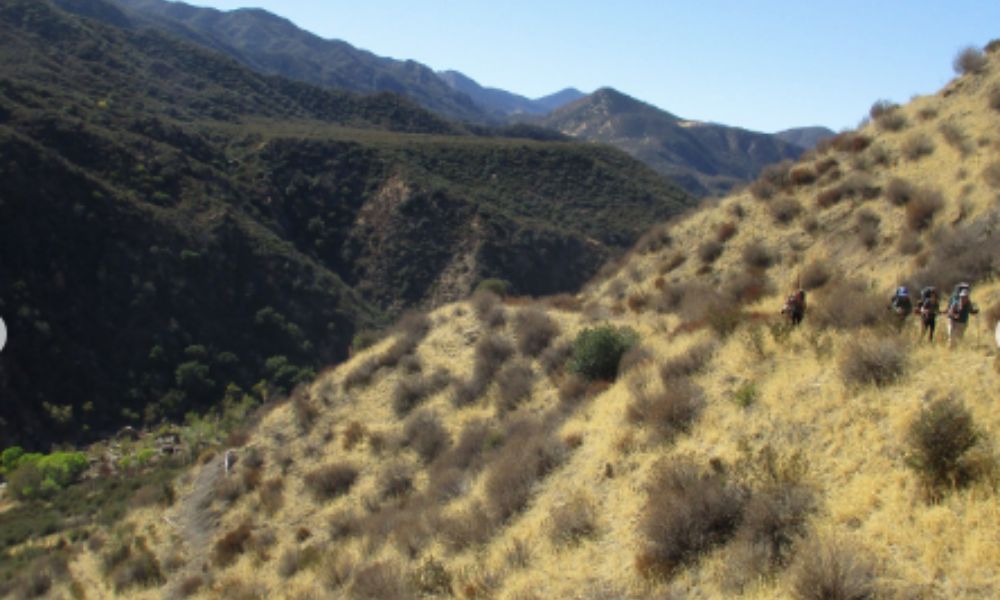
Editorial Note: A little more than a year ago I connected with Zoe Gillis, a licensed therapist and wilderness guide, after booking a 5-day backpacking trip to the Sespe Wilderness with her organization, Wild Minds. The experience changed my life, and it’s time to feature Zoe as the life-giver that she is.
One of Zoe Gillis’ earliest memories of finding solace in nature was watching the fireflies in Central Park.
As a youngster, Gillis split her time between staying with her mother in Los Angeles and her father in New York. She remembered happy times climbing rocks and trees and also of being in awe of the power and challenge of the ocean.
She also remembered a lot of fighting and feeling a lot of anger which, at age 15, led her to “chase down” a therapist who visited her school.
“She basically preached this idea of meeting difficulty with a lot of love and compassion, and that, for me, at 15, in my world, with my parents, was mind blowing to me,” Gillis said via a Zoom call. “I was like, ‘This exists? There are people out there who can get into the difficulty we experience in life and meet it with kindness? Like, what?’ So I chased her down. She was booked, but I kept calling her, because I was like, ‘I want this.’”
Unbeknownst to Gillis at the time, her passions for nature and community would follow her into adulthood. She is now a licensed marriage and family therapist also certified in EMDR Trauma Therapy, Mindfulness and Meditation, and Wilderness First Response.
She has spent her career empowering women to cultivate confidence and resilient mindsets — first by tackling mountains and wilderness areas, then by tackling the changes they need to make in their own lives — through her organization Wild Minds.
Wild Minds offers a variety of services, from one-on-one and group counseling and life coaching to immersive wilderness retreats. While Gillis has a unique gift at connecting people back to the natural world in playful and practical ways, she also ensures that intention drives each individual experience.
Gillis spoke with me over Zoom about her life passions, the importance of getting back to nature and honoring what you need, and her advice for people hesitant to follow the nudges of their souls. The interview below has been edited lightly for style and length.
Those interested in learning more about Zoe or checking out some of her retreats can visit the Wild Minds website here.
A Q&A with Zoe Gillis, Founder of Wild Minds

Can you share more about your introductions to immersive nature experiences and the concept of “being in community”?
I went on an Outward Bound trip when I was 18, and that was my first introduction to extended periods of time in nature. I worked for three months at a wilderness therapy program in Utah, and after that I worked in Canada for two years at a program run by a woman who is First Nations. The focus in that program was on letting there be natural consequences — like, “Oh shit, you forgot your rain jacket, and it’s raining? Well, we’ll have to figure it out!” Or if you weren’t getting along with some of the other participants, “Well, okay, we gotta figure that out, and use that as an opportunity to grow and learn with a lot of care and a lot of kindness,” as opposed to punishment.
As for my introduction to community, I joined a group that my therapist ran. It was usually around 8 to 12 people, from age 15 up through people in their 30s and 40s. We’d all sit around on couches, and sometimes we would be there until 2 or 3 in the morning. That is where I first felt the power of being witnessed and also witnessed that I wasn’t alone, that everyone had different struggles. Just hearing and seeing that there were people who had felt like I had felt and who made it through was very valuable to me. This idea of feeling and learning and growing in community was such a part of my identity then, and it’s an integral part of my experience now.
How does being out in nature help us — whether for short or extended periods?
The book The Nature Fix describes how after three days in nature, people perform 50 percent better on problem solving tasks, creativity, and all that. I also hear this from people who come on retreat, that there is something that happens after three days. For me, the ease of problem solving, creativity, and being able to settle is really helpful.
But when I think about this, I also think about access, and how we can’t all go into nature for three days; I think about who has access to natural spaces and who feels comfortable and invited into wilderness spaces. So I’m always hesitant to say that “In order to be creative…”
It’s not that we need time in nature to be creative, but being out in nature is one avenue that is available to open that up. I think it’s similar to meditation and how people ask, “How long should I meditate?” If you can pause and take three deep breaths, that’s a great practice, AND the benefits you are going to get from that are very different than if you learn how to actually sit for 20, 30, or 45 minutes. Similarly, if you go on an extended retreat out in nature, the benefits are going to be very different.
But to leave space for however people find their way into things is very important.

What have you learned about healing and personal growth in all your self-work and your time helping others?
Growth often looks like destruction. I have this one memory (of time in therapy from young adulthood) of where I threw my keys down and just stomped out of the room because I was like, “Fuck you guys, fuck all of this.” My best friend now, who also is a therapist, was in that group, and she came after me. I remember feeling like the world was crumbling around me. But I decided to go back in that room and keep moving forward. Even though that moment was so difficult, I really do think that crumbling, in some sense, was the crumbling of my old way of doing things. I was moving into a place where I could be more vulnerable and open. But it takes a lot of courage, fierceness, but also gentleness.
You help people become “comfortable with the uncomfortable” — why is that a great life skill to have, whether facing unpredictable weather in the mountains or in the vicissitudes of life?
Learning how to be with discomfort is so valuable. If we’re caught in resistance and struggle, then all the energy goes toward that — to trying to avoid or get out of being uncomfortable, as opposed to zooming out, sitting back and assessing, “How can I be with this in a way that’s actually going to be helpful?”
It’s about being able to widen the container so that there can be discomfort, but there can also be that part inside that’s able to be witnessed. From that place, we can ask, “What do I need?” or “How do I want to respond?” or “What’s the wisest action here?”
Some of the mindfulness tools you teach people about are attention and intention — what’s the difference?
I really believe that most of us want to move toward health and healing. I really think that so many of us want, or have the intention, to care for this planet. And yet there are all these things — society, policies, commercials, marketing — that can pull us off those intentions.
If we’re not really careful with our attention, and where we are putting our attention, and making sure that we’re creating space to check back in and ask, “Am I in alignment? Am I acting in alignment with my intention?” it’s so easy for other things to get in the way.

Do you have advice for people on how they can “tune in” and listen to themselves in such a hectic world?
Being in body is one of the most powerful ways to know what we are feeling and to expand our capacity to tolerate and understand what we are feeling. Being in nature is one beautiful way to get into our animal body — feeling the warmth and the sun and hearing the sounds of the birds. There’s also a science of soft focus, where our brains aren’t having to take in a bunch of stimulation.
You help empower women to do “hard” things out in nature — whether that’s spending 5 days in the wilderness or going to the bathroom outside for the first time. Do those lessons translate into doing “hard” things in life?
I’m always working with people who tell me, “I just want to feel confident, and then I’ll go for the job,” or “Then I’ll reach out to this person I like.” Unfortunately, it doesn’t work in that direction. You have to do the scary thing first. You have to do the hard thing to feel confident and accomplished.
That was such a huge thing for me with nature. Every time I lead a trip, I feel like, “Why did I do this?” because it’s really hard. But there’s something that draws me, that I can’t even quite explain. That pull was natural.

Do you have advice for people who might feel a similar “pull” — but wonder whether they can trust following it?
I run questions like that through the filter of “Is the block to doing this thing fear?” If there is a nudge, then I think it’s really worthwhile getting to know those fears and pushing through them a little bit.
There are times when I hear people with hesitations about going on a retreat, and it’s not that they’re afraid; money, for example, could be a really big one for people. It’s the difference between, “I have the money, but I’m just a little scared to take that leap” vs. “Oh, if I do this, I’m literally not going to have enough money.”
Same with time. Some people fill their schedules and are constantly going from thing to thing to thing, so the scarier thing would actually be to say “No” and to leave more space in their schedule or to spend that time outdoors.
It’s about asking, “What am I actually afraid of?” If it’s only fear standing in the way, then leap! Take the jump, do it. But if it’s not fear and it’s reasons like, “I’m not afraid, but I’m sitting with this and it’s just not right,” then honor that.
No matter what — whether it’s doing a really hard backpacking trip, or a more gentle immersive nature retreat — the only way to know what is right for your soul is to be paying attention and to really be listening.
There’s no formula for this because we’re all so unique, and so the formula is to be able to learn how to listen to your own ingredients and what you really need.
And that is an ongoing practice for our entire lives.
 Compassionate Coexistence
Leave a comment